
New results (11/06/2026)
Team LSFCWhen Bordeaux Mixture is widely used in agriculture, particularly in our wine-growing regions, the copper it contains remains a pollutant, becoming toxic to plants beyond a threshold concentration. However, decades of intensive use have contaminated many soils, making it necessary to research effective, easy-to-use, and low-cost decontamination methods.
A study conducted by two teams from ISEC (ICSM/LSFC and DMRC/STDC/LPSD) focused on the combination of leaching with biosourced reagents and ultrasonic irradiation, as part of Rita Salameh's thesis, co-funded by the Occitanie Region. The results indicate that in citric acid medium, the increase in decontamination yield at 1 hour can be attributed to the sonification-accelerated dissolution of calcite and diffusion. Sodium humate can also mobilize copper in alkaline medium. Under these conditions, sonification also improves the soil extraction yield, which increases from 23.6% in the absence of ultrasound to 30.5% at 45 kHz and to 37.6% at 358 kHz. Its effect is particularly marked on the fine sand grain size fraction, with an increase in yield from 18% to 43%. This is explained by the fact that sonification would induce the disaggregation of the largest particles and favor the transport of copper-containing particles by the micelles formed by humic compounds. This study highlighted the potential of high-frequency ultrasound to improve the extraction of copper from a real soil, and in a more significant way than low-frequency ultrasound (45 kHz).
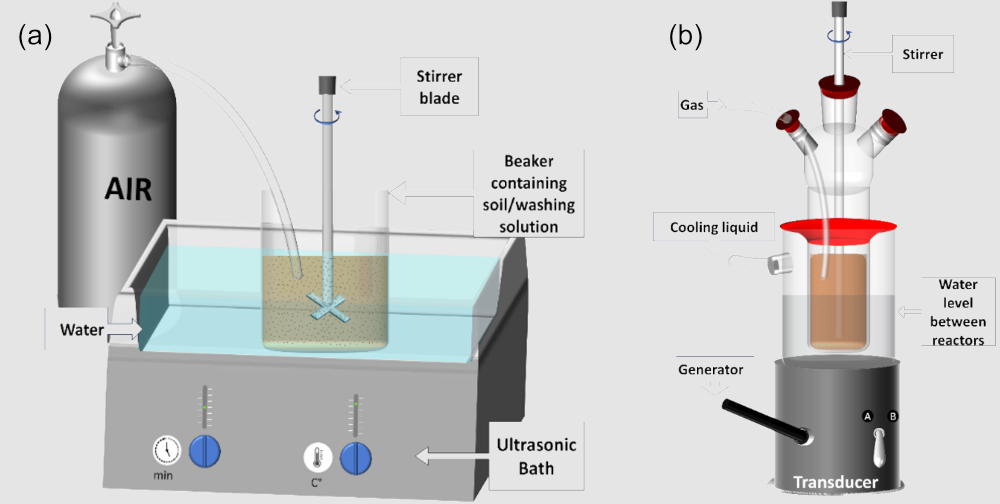
Figure 1: Setups used for soil decontamination by washing coupled with ultrasound at a) 45 kHz and b) 358 kHz.
Credit: ICSM
This work was the subject of an article published in Ultrasonics Sonochemistry:
R. Salameh, A. Leybros, S. Szenknect, R. Pflieger. Remediation of sandy loam soil contaminated with copper by washing assisted with ultrasound. Ultrasonics Sonochemistry 130 (2026) 107893. DOI: 10.1016/j.ultsonch.2026.107893.
Contact: Rachel Pflieger