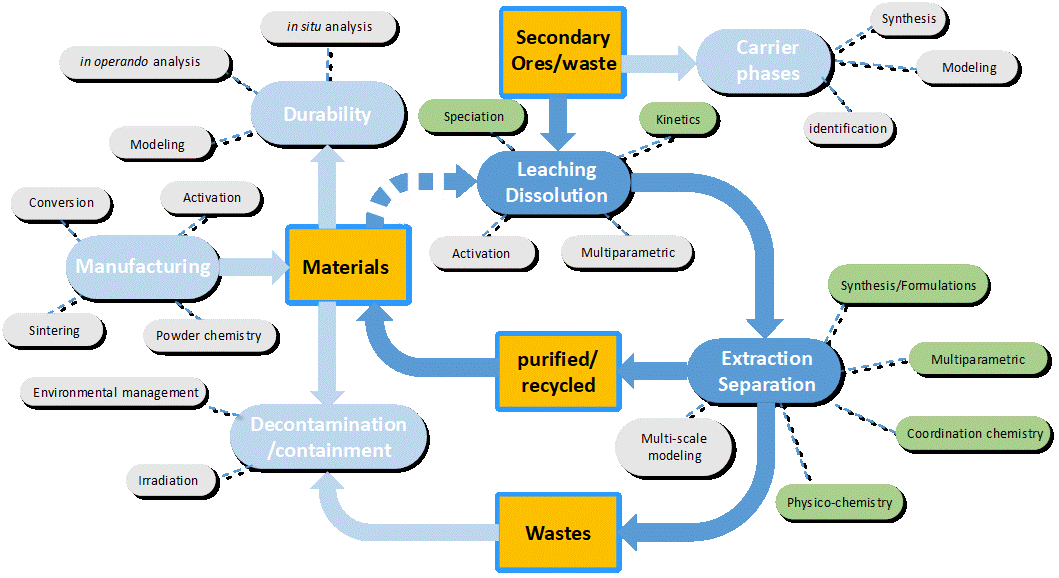
The team’s scientific focus cuts across two research areas proposed at the ICSM: Innovation for Recycling and the Life Cycle of Materials. The studies conducted at the laboratory focus on describing and understanding the properties of metal-based molecular and supramolecular systems (d and f). The aim is to determine the role of interactions between a metal centre and its immediate and distant environment in a process of matter organisation, and then to harness this organisation to form either metal-specific complex organic phases or specific coordination polymer-type assemblies. In this context, the team does not seek to develop new tools (new molecules, new solids, new synthesis methodologies), whilst possessing a thorough mastery of existing tools, including mechanistic aspects at the molecular level. The systems studied are then aimed at developing innovative two- or three-phase separation processes, targeting various metals of interest with diverse physicochemical properties (valence, charge density, etc.), such as transition metals (Pd, Au, Ni, Co, Mn, V, Ru, Al, Sc), the lanthanides or the actinides (U, Th and Pu).
The controlled management of processes designed to treat an incoming stream of variable composition is addressed at a fundamental level through various adaptive separation approaches. Following on from the use of fluorinated compounds, our understanding of the relative importance of strong and weak interactions in the extraction and separation of metals has enabled us to propose an original approach based on the spontaneous demixing of organic phases. Using a conventional organic phase based on tributyl phosphate (TBP), an initial two-phase system is obtained following the extraction of U and Th at high temperature (T1, 70°C). The two phases are separated, then the organic phase loaded with U and Th is cooled below a critical temperature (approximately 50°C) at which it separates into a heavy organic phase and a light organic phase. Two streams are thus obtained: the first contains almost all the Th along with a portion of the U, in a controlled ratio; the second contains the excess U. The U/Th ratio in the heavy phase is controlled by the final temperature of the system (J. Durain’s thesis, a).
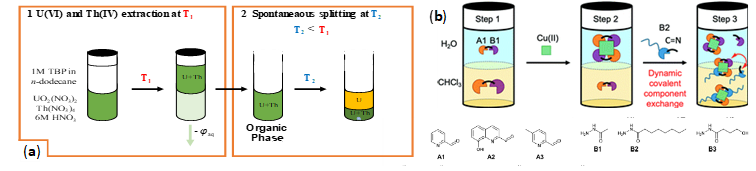
The development of adaptive systems has also been explored through an approach based on the use of dynamic covalent libraries: unlike the conventional method, in which a single molecule is designed to extract metal cations under specific conditions, dynamic covalent chemistry enables the generation of extractant species to be triggered by the composition of the medium. In collaboration with the LCS (ISIS), the LHYS team applied this approach to the extraction of copper(II) nitrate using an organic phase based on a dynamic library of acylhydrazone-type constituents that self-assemble and distribute themselves within the two-phase system (b). The addition of copper(II) cations to this library triggers a change in its composition and the regulation of ligand molecules driven by coordination with the metal cations (A. Chevalier’s PhD thesis, followed by R. Moneuse’s PhD thesis).
The molecular systems studied are then used to develop short loop recycling approaches.
In the context of the nuclear fuel cycle, the studies carried out aim to simplify a safety-driven closed cycle through the controlled management of actinide mixtures. The separation process is controlled by a judicious choice of the molecular topology of the extractants used, mainly malonamides, which allows manipulation of the kinetic (theses by S.A. Moussaoui and M. Khoder) and thermodynamic (theses by E. Makombé and L. Golfier) aspects of the separation. These two aspects are examined in particular detail at the molecular level, notably through collaboration with the JAEA.
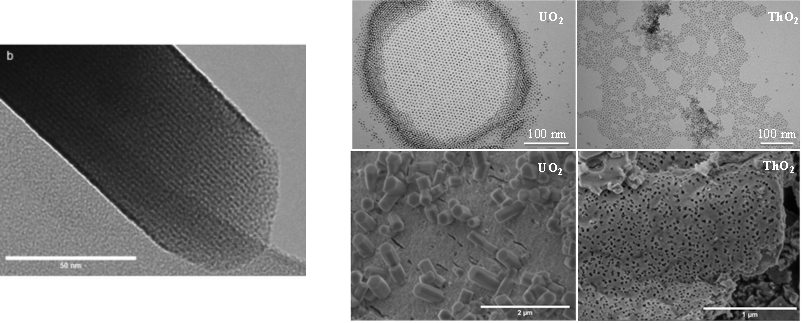
The approach also addresses the materials aspect through the direct and controlled synthesis of actinide materials, either pure or in mixtures, organised at the nanoscale (M. Henry’s PhD thesis). As hybrid materials organised at the nanoscale can exhibit unusual properties compared to conventional inorganic materials, the team has developed two bottom-up approaches aimed at the controlled preparation of this type of material. Firstly, we developed a one-step approach leading to lamellar nanosheets using a ternary molecular system (dicarboxylic acid, oleylamine, dibenzyl oxide; E. Ré’s thesis). In these nanosheets, the interlamellar distance can be adjusted depending on the length of the dicarboxylic acid used. The second approach, based on the functionalisation of nanoparticles, demonstrated that it was possible to use click chemistry as well as electrostatic interactions to construct materials organised through the association of nanoparticles.
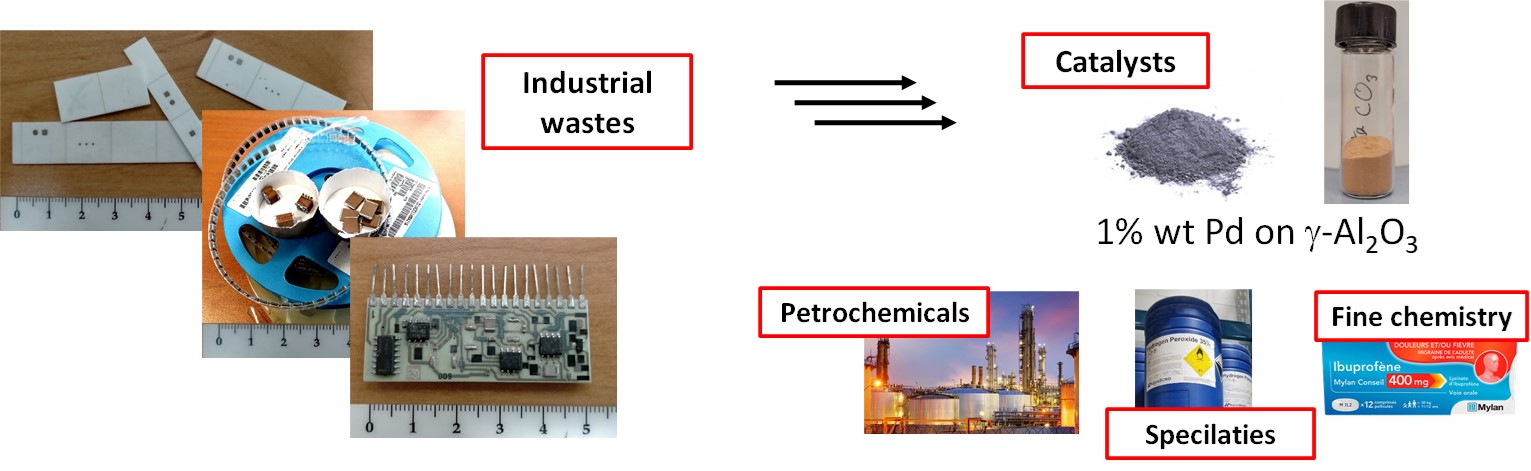
In the waste and recycling industry, the approach developed aims to improve the value chain through the direct production, without purification, of high value-added compounds, whilst taking economic and ecological models into account.
• Firstly, in an open-loop system, through direct recovery following the extraction of precious metals (Pd, Au) contained in electronic or industrial waste: Building on previously published fundamental studies, the team has developed various hydrometallurgical approaches for Pd recovery. In collaboration with various groups, it was subsequently possible to propose a short recycling pathway for Pd through its direct recovery as a catalyst (V. Lacanau’s PhD thesis). This work is continuing as part of the CAREME project, funded by the ANR and coordinated by the team (M. Martin Romo y Morales’s PhD thesis, contracts for A. Brunet-Manquat and D. Nikolaievsyi). Finally, it should be noted that all the research carried out in this field has led to close collaboration with the company SOVAMEP to optimise the recovery of precious metals. This collaboration has recently been extended by the award of a BPI France 2030 funding (MOTRIS project).
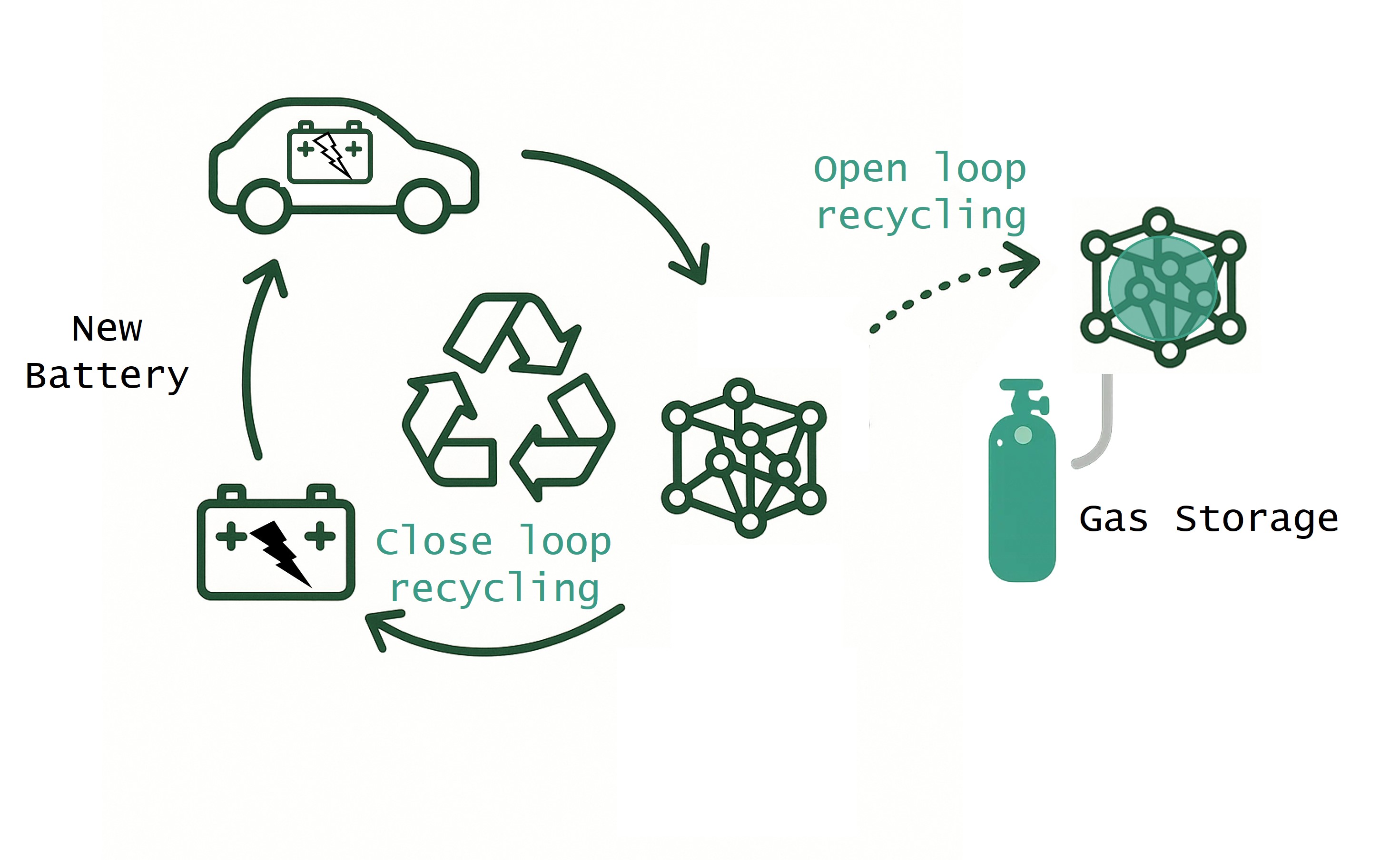
• In a closed-loop system as part of the development of precursor materials for energy storage: Energy storage and its circular economy represent a major societal challenge for the years to come. In this field, the LHyS team is keenly interested in the Li-ion battery cycle, and more specifically in that of the active electrode, using an integrated approach based on various hydrometallurgical processes. This cycle involves the synthesis, dissolution and separation of species within a closed-loop system, primarily based on the use of hybrid materials such as MOFs (Metal-Organic Frameworks; see the PhD theses of M. Cognet and T. Riant). All these activities encompass both fundamental and applied research and involve several external national and international groups, including the SCARCE project.
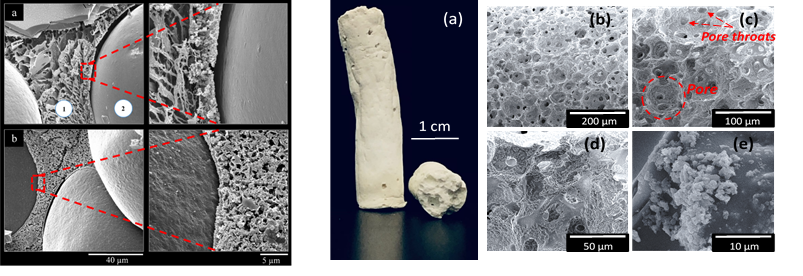
Finally, more generally, to address the lack of methods for shaping porous materials with broad applicability, we have developed, in collaboration with a team at CEA Marcoule, an approach for preparing hierarchically porous materials based on the stabilisation of Pickering emulsions using MOFs (F. Lorignon’s PhD thesis). Other methods for shaping MOF-based materials are currently being investigated in the laboratory, such as 3D printing (contract) or thin-film deposition (G. Genesio’s PhD thesis, B. Mortada’s postdoctoral research).